This is carousel is draggable through mouse or trackpad. Use keyboard tab to control navigation buttons, third tab enters slides, use arrows to navigate slides and tab to exit slides.

Companion Pieces
This is a carousel is draggable through mouse or trackpad. Use keyboard tab to control navigation buttons, third tab enters slides, use arrows to navigate slides and tab to exit slides.


Collector's
Gallery
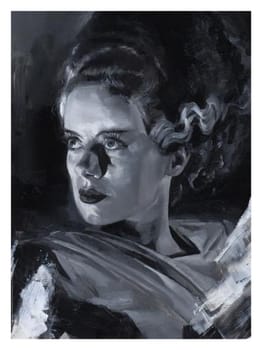
"You have created a man. Now, together, we will create his mate."
So states the deviant and devious scientist Dr. Pretorius, who blackmails Dr. Henry Frankenstein into resuming his heinous experiments, with the ultimate goal of creating a female counterpart for the Monster. The 1935 film, The Bride of Frankenstein, was director James Whale's superb follow-up to his enormously successful Frankenstein, which introduced Boris Karloff's Monster to the film-going public, and, ultimately, to the pop-culture lexicon. "Bride of Frankenstein" elaborates upon and expands the mythology of the tragic Monster, who, while still capable of great violence, is depicted as a lonely, sympathetic figure longing for companionship. The sequel is a marvel of noir cinema, filled with cavernous sets, evocative lighting and vivid characters including of course, Elsa Lanchester's magnificent title character. The Monster's loneliness, brief moments of happiness and desire for companionship lend genuine pathos to the film. Add a plot that moves along at a solid clip, moments of dark humor seasoned with liberal doses of well-placed camp and strong thematic material that glides just under the film's dark surface, and it becomes clear why The Bride of Frankenstein is regarded as classic cinema.