Batcave Files: The Most Twisted Rogues Gallery Villains
The DC super-villains who belong in Batman’s Rogues Gallery are among the best of the worst. Each is iconic in their own way, establishing personal legends with their unforgettable neuroses and ingenious plans. Up against the World’s Greatest Detective, these villains must be able to hold their own, after all.
But even legends sometimes need a reimagining, a new look for a new day. Throughout the countless Batman stories, shows, and films, we’ve seen these Rogues Gallery villains undergo astounding transformations. Let’s examine a few that have really pushed the limits of each character, bringing a whole new villainous aspect to life.
The Penguin from Batman: Caped Crusader

Though she only appears in one episode (so far), this alternate version of The Penguin certainly makes a splash in the premiere episode of Prime’s new DC animated series Batman: Caped Crusader. Oswalda Cobblepott is a woman of duality — strong and imposing yet flirty in her cabaret act, philanthropic yet embezzling, ruthless yet … well, no, actually she’s extremely ruthless. Honestly, she might be one of the most cutthroat versions of The Penguin out there.
With her dapper suit and suave smooth talking, she charms Gotham’s elite. Unlike most Penguins, she is in the good graces of high society, which helps her put the GCPD in a chokehold. But when the spotlight is off and the curtains are drawn, this super-villain is willing to send anyone who crosses her to sleep with the fishes. Even her son. And that’s just the tip of the Iceberg Lounge with this shady swindler. There’s just enough of traditional Penguin to be recognizable but at the same time, Oswalda plunges the villain into colder depths and even more chilling schemes.
Cyberpunk Harley Quinn
section contributed by writer Jasmine Edwards

Designed by Stanley “Artgerm” Lau, the Cyberpunk Harley Quinn by Prime 1 Studio imagines the troublemaker far in the future. Dripping in neon colors and metallic aesthetics, this Harley looks like she could go toe-to-toe with any replicant from Blade Runner. In this reimagining, the already dark and corrupt Gotham reaches new societal lows as technological advancements are on the rise. Harley Quinn remains the antihero we all adore, shifting to whichever side best suits her needs and strong emotions at the time.
Harley Quinn keeps changing
Everyone’s favorite Clown Princess actually has a lot of interesting iterations across media formats. While she doesn’t have a blank slate of a concept, her character is malleable enough to constantly change. Dr. Harleen Quinzel from The White Knight comic series has a pretty standard origin story. However, eventually a second Harley Quinn called the Neo-Joker emerges in those comics. The two Harleys have totally different motives and goals, opposing each other at every turn as a reflection of Harley’s character growth over the decades. Additionally, Harley Quinn Who Laughs from Dark Knights: Metal is the darkest and most twisted incarnation of the character yet.
Birds of Prey Harley Quinn emphasizes Harley’s intelligence and relationships outside of her abuser, especially with other powerful women. Caped Crusader Harley is a sadist who uses extreme methods to “help” her patients, but is otherwise not a villain. And the upcoming Joker: Folie à Deux film explores a musically minded Harleen Quinzel who seems to also reside in a psychiatric hospital like Arthur Fleck. There are so many possibilities when it comes to the Clown Princess — some straight-up nightmarish and others an absolute Neon Dream (RSVP here for Sideshow’s upcoming take on a futuristic Harley Quinn!).
Poison Ivy from Batwoman

Due to her connection to nature, Poison Ivy has always been a unique villain. She’s capable of endless transformations as she crosses over into different seasons within her career. Plus, her underlying goal is ultimately admirable: Poison Ivy seeks to protect nature and, in turn, the planet itself. Her methods, however, are what get her into trouble with the Bat-Family and Gotham’s various protectors. She straddles the line between danger to society and tentative antihero. But the version we see in the Batwoman TV series is among one of the more intriguing iterations of Dr. Pamela Isley.
In the past, Pamela was in a relationship with Renee Montoya. This pushed Ivy to strive to be better but, in the end, her goal in giving nature the upper hand won out. But Renee, with the help of Batman, tricked Ivy and injected her with a desiccation serum. Dried out and powerless, she was stuck underground for a decade until Renee’s grief became too much. Once Ivy was freed again, she used Mary Hamilton, Batwoman’s stepsister, to regain power. Ivy’s influence leads Mary into becoming a second Poison Ivy in a compelling character arc that challenged Mary’s relationships with her friends and family. Though things get pretty thorny, fans of Ivy will be glad to know there is a happy ending for Poison Ivy and her lover, Renee.
Martha Wayne as The Joker
section contributed by writer Jasmine Edwards

Flashpoint rocked DC to its core. This event occurs because Barry Allen, AKA The Flash, goes back in time to stop his mother’s murder. In doing so, he obliterates the original DC timeline. All of the Justice League members are either nonexistent, destitute, or dead! Thankfully, Batman still exists in Barry’s new timeline. When Barry — lacking powers — goes to see Bruce Wayne, though, it’s not Bruce. Because of the timeline alterations, the Wayne who died in the alley was Bruce. Thomas Wayne’s anger and grief catalyzed his transformation into the Dark Knight. His version of Batman is decidedly different; he even beats Joe Chill to death.
Unfortunately, Martha Wayne’s survival of the tragic incident does not prompt her to seek justice. Martha has a complete mental breakdown, cutting her face open to create an everlasting smile when she can’t seem to move on from her son’s murder. Thomas has her institutionalized, but she escapes to begin a life of chaos and crime. Martha Wayne’s Joker is her husband’s arch-enemy. She wants to burn Gotham to the ground, and almost succeeds. It’s a really fascinating and unique take on the Clown Prince of Crime, especially because it further emphasizes the inescapable similarities in any universe between The Joker and Batman.
Two-Face from Batman ’89

Harvey Dent is always a cautionary tale of two sides of the same coin. As Gotham’s golden boy district attorney, he is a figure of fair-minded justice. Yet something always happens to tip his scales toward unequal madness. And usually, by a cruel twist of fate, Batman is at fault for Harvey’s grotesque transformation into Two-Face — at least in Harvey’s eyes.
For this version of Two-Face, the interesting twist is that he is a continuation of the Harvey Dent we meet in Tim Burton’s Batman films. In fact, Batman ’89 is written by Sam Hamm with art by Joe Quinones and colors by Leonardo Ito, and it takes place right after Batman Returns. It’s a story that builds upon Burton’s beloved Batman cinematic universe in which Billy Dee Williams played Harvey Dent. This Harvey is involved with Barbara Gordon and he quickly closes in on uncovering Batman’s secret identity. He also tries to look out for the Black community of Burnside, one of Gotham’s neighborhoods. Of course, circumstance always forces Harvey to lose his sanity, and this one suffers from frequent hallucinations. Eventually, his fate is sealed in the Batcave by Catwoman after he deduces the truth behind Bruce and Drake Winston’s vigilante activities.
Mr. Freeze from Batman: The Animated Series

Batman’s Rogues Gallery is certainly filled with its fair share of gimmicks. After his comic book debut in 1959, Mr. Freeze was not set up to be much more than a villain with ice-based weaponry and a flimsy lab accident origin. However, the groundbreaking Batman: The Animated Series, a favorite among fans as well as critics even today, managed to break the ice and shape Victor Fries into something much more powerful — and human.
Thanks to Paul Dini and Bruce Timm, Freeze’s backstory was redone. Victor Fries became a scientist whose wife, Nora, fell ill. Since her terminal illness didn’t have a cure yet, he used cryogenics to freeze Nora and give himself time to discover a cure for her. But the cruel CEO of GothCorp shut down Fries’ experiment and pushed him into a vat of chemicals. Victor’s physiology adapted to the cryogenic temperatures but his heart was permanently frozen over against anyone but Nora. This first episode featuring Mr. Freeze, “Heart of Ice,” gave new life to the character and even propelled him to make a comeback off the screen and in the comic books. Now, Mr. Freeze is a vital member of the Rogues Gallery and his backstory with Nora is a constant in Batman lore.
Selina Kyle from Gotham
section contributed by writer Jasmine Edwards

We’re so used to seeing comic characters stay stagnant at the same age. No matter the iteration, Selina Kyle is usually a fully fledged adult, slinking around the shadows and well into her cat burglary career. Gotham posits a much younger Catwoman, though, in order to match their 12-year-old Bruce Wayne. And when have we ever really seen Catwoman as a kid? The show features Selina as a scrappy, skilled thief with a bad attitude and lots of loneliness. She doesn’t even have a vigilante alias yet.
While the character’s personality doesn’t change all that much from what we’d expect, it’s nice to see an origin story that focuses and highlights the hardships of youth. Plus, it’s cool to see a Catwoman concept that doesn’t rely entirely on sex appeal and leather outfits. Gotham does introduce an adult Selina in the last season, which jumps ahead a decade. However, it doesn’t fall back on the classic Catwoman outfits or behavior. Such a dedicated push against established tropes is refreshing for sure!
Talia al Ghul from The Dark Knight Trilogy
section contributed by writer Jasmine Edwards

The Dark Knight Trilogy is best known for its grounded takes on Gotham City villains. Director Christopher Nolan’s realistic approach to Batman’s Rogues Gallery basically set a precedent for live-action Batman media moving forward. One such villain who got TDK’d is Talia al Ghul. In the comics, Talia is known as the Daughter of the Demon. She is a semi-immortal assassin, as well as Batman’s enemy and lover. Ruthless and mercurial, she is part of the League of Assassins and more loyal to her father, Ra’s al Ghul, than to Bruce Wayne.
Instead of the leather-bodysuit-clad, sword-swinging femme fatale, The Dark Knight Rises introduces Talia through an awesome twist. At first, Talia is the idealistic and independent Miranda Tate. She promises an environmental and modern solution to energy problems in Gotham through her nuclear core. Unwilling to let Bruce waste away in solitude, she also encourages him to return to his work at Wayne Industries. But the entire time, Talia is emotionally manipulating the vigilante so she can destroy his city with a bomb.
Bane and Talia
Nolan expertly juggles multiple villains in his stories. He also weaves their narratives together, illustrating how interconnected all evil really is. In the case of The Dark Knight Rises, Bane appears to be the main antagonist. He fulfills his role as The Man Who Broke the Bat. However, Talia is actually the mastermind. She was raised in the prison where Bane spent most of his life, and he became her guardian. Because of this, he’ll do anything for her — including dying for her cause. Talia revealing her true identity as her greatest friend dies is still a chilling scene over a decade later.
These are only a few of the fan-favorite Batman villains who have been transformed into nearly unrecognizable yet still compelling characters. Who are some of your favorites? Join the conversation with other DC fans over at Sideshow Social Network or in side.show/geekgroup, and don’t forget to Let Your Geek Sideshow!
For even more innovative twists on fan-favorite villains, be sure to check out The Joker and Harley Quinn: Lawless Love Diorama. This new original DC collectible by Sideshow joins the Mythos collection in a reimagining of Gotham’s most wanted as if they were lovers on the lam in the 1930s. Keep your eyes peeled for even more exciting takes on iconic DC heroes and villains coming soon.
By Nick Cimarusti

More from Nick
- One of Those Faces: DC’s Clayface Film Review
- The Most Monstrous Villains of Batman’s Rogues Gallery
- Catch the Scariest Reptiles on World Reptile Awareness Day!
- Are You Ready to Face the Scariest MCU Moments?
- Creatures + Comics! The 10 Best Spooky DC TV Episodes
✍️ Written by Humans, Not AI
Related Products
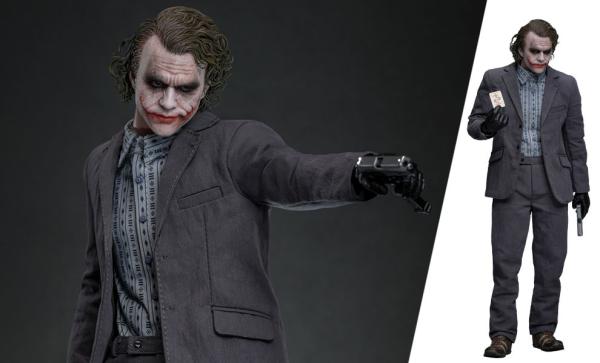
The Joker (Bank Robber Version) (Special Edition)