VisionQuest Premiere Review: What It Means to Be Human
Originally published October 15, 2026. This article covers the review of the first two episodes of Marvel’s VisionQuest.
The long-awaited conclusion to Marvel’s WandaVision trilogy is finally here. VisionQuest made its grand debut last night with its first two episodes, laying the groundwork for a compelling narrative full of technological magic, thoughtful character studies, and a human-looking Ultron who really should narrate a few audiobooks.
The Ship of Theseus

The WandaVision finale introduced the Ship of Theseus Paradox, which Vision and White Vision debate. It’s no surprise that VisionQuest delves into this thought experiment in great detail — really, it’s the show’s thematic crux.
White Vision, or rather now the only Vision, was created under very different circumstances as opposed to the Vision who came before him. In this instance, can someone be the same as they were before if all their parts have been replaced? Sure, the Vision in VisionQuest looks like the Avenger we know and love. However, as he tells everyone in his mind palace (which I’m calling Vision’s mansion; thanks, BBC’s Sherlock), he has former Vision’s memories but not his feelings.
VisionQuest isn’t afraid to get philosophical. It allows us to examine this relatable question through the lens of this candy-colored, artificial universe. I also love that Vision’s mind palace is a retrofuturistic, vibrant, 1950s-esque world that pays homage to WandaVision’s all-American sitcom references. Vision, or “Sherwood Ellis,” even kicks off the first episode by watching Sanford and Son, which feels like a fun wink to WandaVision.
Even though this Vision doesn’t love Wanda like his predecessor, these ties to WandaVision give VisionQuest more depth. Paul Bettany subtly carves out the differences between this Vision, the one in WandaVision, and the version pre-Thanos. He delivers understated work here. Even with similar vocal inflections and physicality, you truly believe this Vision is not like the others.
There Are No Strings on Me

James Spader is, expectedly, a scene stealer. I didn’t think I’d be this excited to reunite with Ultron. He’s much less intimidating (and destructive) in VisionQuest — he’s more like that a-hole professor who thinks he knows everything. Spader is still formidable, though, as the towering AI that tried to destroy humanity. I love the jokes Ultron cracks about teetering between wanting to learn from humans and kill them.
J.A.R.V.I.S., F.R.I.D.A.Y., and E.D.I.T.H., Tony Stark’s most fully formed AIs and brought to life by Vision, aren’t fans of Vision keeping Ultron in his mind palace. However, VisionQuest is also a thought-provoking examination of father-son relationships, and I have no doubt that it’ll delve into Vision’s complicated connection with Ultron.
There’s a fascinating dichotomy between Vision and Ultron despite being cut from the same cloth. Ultron is enlightened, learned, and he harbors a deep understanding of human culture. Meanwhile, Vision, who’s retracing former Vision’s steps to discover how he existed in the real world, knows little about people. Vision and Ultron’s back-and-forth is fun to watch — like two academics debating the merits of humanity.
VisionQuest seems to paint Paladin as the villain, but something tells me it’s a red herring. We see moments when Ultron could revert to his old programming, as it were. After all, if you give him a box of explosives (and I’m paraphrasing here), he might wreak havoc again.
However, I’m also content to have him be the angel and devil on Vision’s shoulders, advising him as he tries to figure out who ordered Paladin to kill him and navigate his dynamic with Tommy.
Like Father, Like Son

Speaking of dynamics, I already know I’m going to like Vision and Tommy as a father-son pair. Ruaridh Mollica has been fantastic as Wanda and Vision’s son thus far. I hope he gets to reunite with Billy soon (Young Avengers, anyone?).
VisionQuest shows that, despite not being physically related, Vision and Tommy really are similar. Episode 2 ends with Ultron muttering, “Like father, like son,” when Vision remarks that Tommy didn’t listen to him. In the first two episodes, Ultron offers Vision advice and even takes action to push him in the right direction, only for Vision to ignore it all. After Paladin injures him, Vision urges Tommy to save himself, but Tommy circles back with a getaway car.
As visually immersive and enthralling as the special effects are in this show, it’s the grounded performances and complex character dynamics that keep me invested. I’m excited to see how Vision, Tommy, and even Ultron develop over the next six episodes.
Just A Rather Very Intelligent System

Paladin severely harms Vision by shooting him with Adamantium, damaging the latter’s mind palace. J.A.R.V.I.S. sacrifices himself by deleting his code to divert processing power to the other AIs. It’s a heartbreaking moment, perhaps more so for longtime Marvel fans who remember when Paul Bettany voiced the character and have watched James D’Arcy as human Jarvis in Agent Carter.
Another real-world, relevant theme that VisionQuest explores is the nature of artificial intelligence and its role in our society. While Vision seems to be more stoic, J.A.R.V.I.S. and the other Stark AIs come across as more “human.” AI is advancing at an incomprehensible rate. Could it get to a point where AI has “emotions?” Maybe that’s a question for someone far more intelligent than me.
Regardless, the first two episodes of VisionQuest are an absolute blast. WandaVision and Agatha All Along are two of Marvel’s best live-action shows, and I’m certain the creatives behind this series will stick the landing.
What did you think about the double-episode VisionQuest premiere?
Join the conversation with other Marvel fans over at Sideshow Social Network or in side.show/geekgroup, and don’t forget to Let Your Geek Sideshow!
By Melody McCune

Connect with Melody
More from Melody
- 5 Highlights from Marvel’s WandaVision Halloween Episode
- 10 Spooky Doctor Who Episodes to Watch for Halloween
- Lanterns Season 1 Finale Review: Fear Is Power
- 10 Non-Gory Halloween Movies for a Macabre Marathon
- 12 Halloween-Themed Disney Movies to Get Your Spooky On
✍️ Written by Humans, Not AI
Related Products
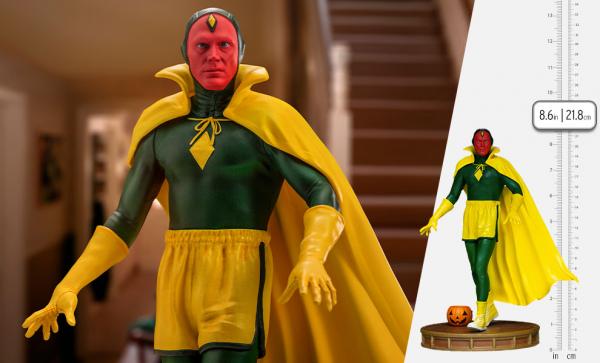
The Vision
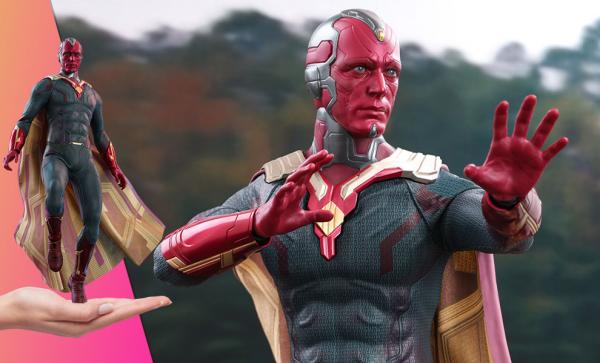
Vision
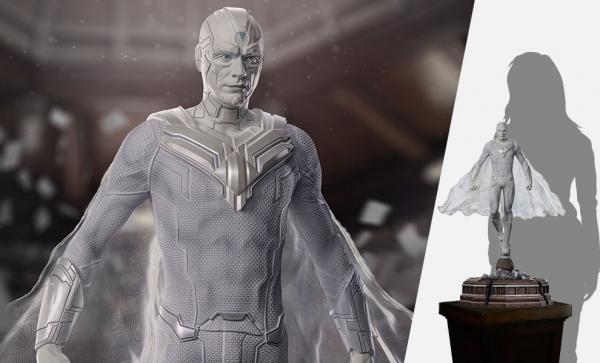
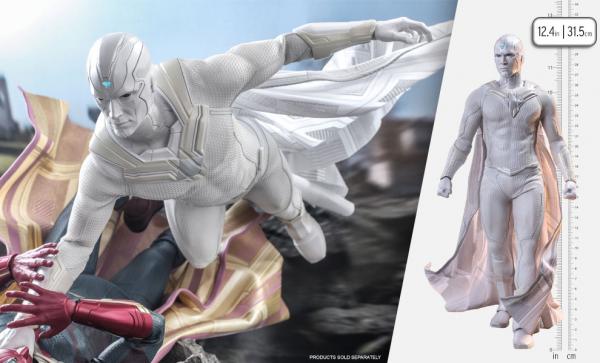
White Vision