Pop Culture References: What Does Klaatu Barada Nikto Mean?
Many characters in pop culture become iconic because of their catchphrases. These slogans, battle cries, and other exclamations are memorable and often quotable — from, “I say thee nay!” to “These aren’t the droids you’re looking for.” And whether you’re a sci-fi diehard or not, there’s a chance you’ve heard “Klaatu barada nikto” somewhere.
This enigmatic phrase has hopped across the fandom multiverse, becoming famously referenced and parodied in countless contexts. But where did it originally come from and just what does it mean, exactly? For that answer, we’ll need to take a trip back through time to 1951 for some truly classic science fiction.
Klaatu Comes from The Day the Earth Stood Still

First portrayed by actor Michael Rennie (referenced by name in Rocky Horror‘s “Science Fiction Double Feature”), Klaatu is a humanoid alien character from the film The Day the Earth Stood Still. He comes to Earth with his robotic companion Gort, whose own design is also quite memorable in movie history. The character’s true origins actually stretch back to a 1940 short story by Harry Bates called “Farewell to the Master,” though Klaatu only has a brief appearance and dies quite soon in the story.
In The Day the Earth Stood Still, Klaatu tries to engage with and study the planet and its populace. Fearing Earth’s aggression against other spacefaring peoples, the alien attempts to show humans the consequences of conflict rather than peace — however, his demonstrations of alien power are taken as an act of war, rather than a warning. Klaatu is killed by the U.S. Army, angering the robotic sentinel Gort. In his dying moments, Klaatu tells a woman to say the words, “Klaatu barada nikto” to Gort, which spares her and others from his retaliation.
Since then, this bizarre trigger phrase has captured audience imagination. Keanu Reeves, who played Klaatu in 2008’s remake of The Day the Earth Stood Still, insisted that the phrase be featured in the script as an homage to the original. But what does it mean when translated?
The Translation of Klaatu Barada Nikto
Screenwriter Edmund H. North both wrote the screenplay for The Day the Earth Stood Still and created the alien language used in the film. And while the clarified spelling of the phrase first came from unearthed movie scripts, “Klaatu barada nikto” is not actually given an official translation. Many individuals have had theories, and some involved with the film’s production have even offered their interpretations.
A philosophy professor by the name of Aeon J. Skoble proposed that given its context in the film, “Klaatu barada nikto” is a robotic fail-safe. He posits that this is part of the core theme of science fiction: Intelligent machines will misuse or abuse their power, and this phrase is used to get Gort to stand down and deescalate the situation.
Fantastic Films magazine’s alien linguistics editor Tauna Le Marbe tried to translate all of the alien speech in the film. Through this, the literal translation of the phrase would be close to, “Stop barbarism, (I have) death, bind,” which would more loosely be, “Do not retaliate, I die, repair me.”

From the Filmmakers
Director Robert Wise stated in a documentary interview that Edmund North once told him that it was just a nonsense phrase that sounded good, but wasn’t grounded in any concrete linguistics. Actor Billy Gray, however, theorized the words “barada nikto” meant “Save Earth.”
When accepting the AFI Life Achievement Award in 1998, Wise also joked in his speech’s conclusion, “…I’d like to say ‘Klaatu barada nikto,’ which, roughly translated tonight, means ‘Thank you very much from the bottom of my heart.'” As touching a sentiment as that is, we doubt that’s really what Klaatu had in mind as his dying words.
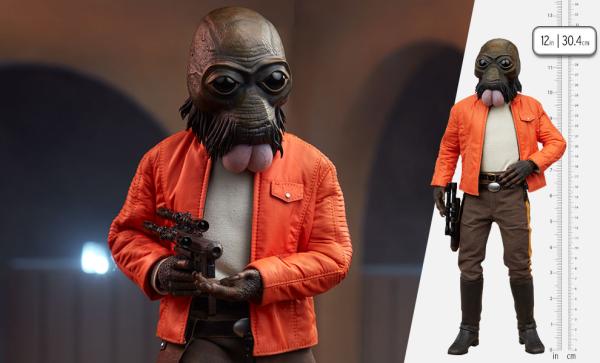
Klaatu, Barada, and the Niktos Are Aliens in Star Wars
The Star Wars™ galaxy is filled with fun and creative characters that not only redefined science fiction as we know it, but also pay homage to other staples of the genre. Therefore, it shouldn’t surprise anyone to hear that “Klaatu barada nikto” is well embedded in the franchise, beginning with Return of the Jedi™. You’ll find these references among the criminals aboard Jabba’s sail barge.
Aliens Klaatu and Barada are two of those found in the circles of scum and villainy associated with Jabba the Hutt’s empire. Klaatu was in charge of repairing skiffs and enjoyed gambling and viewing executions. The alien attempted to confront Luke Skywalker at the Great Pit of Carkoon, but was disarmed and later died in the barge explosion. Barada also accompanied the crew to the battle at the sarlacc pit and was similarly dispatched by one swift strike of Luke Skywalker’s lightsaber.
References Hidden in Species Names
But those aren’t the only references hiding on the Khetanna or in Star Wars canon. In fact, the species of these characters further the homage.

Klaatu is a green Nikto — also known as a Kadas’sa’Nikto from the planet Kintan. Green-skinned Niktos were known for their scaly skin, black eyes, and horned features. A similar but slightly divergent species, the Kajain’sa’Niktos, were also called red Niktos. With a slightly more insectoid look, these red-skinned Niktos also hailed from Kintan and had scaly skin with horns and spikes. Notable Kajain’sa’Niktos included Vizam, who also served Jabba the Hutt, and Jedi Master Ima-Gun Di.

As for Barada, he is a Klatooinian, from planet Klatooine. These aliens were known for their toothy overbites and imposing brows. Their muscular builds made them easily suited for work as bounty hunters or hired muscle. Barada is also seen alongside fellow Klatooinian Kithaba — the two can be told apart by their signature headbands (Kithaba’s is red, Barada’s is yellow).
So you have Klaatu the Nikto and Barada the Klatooinian — “Klaatu barada nikto” indeed.
Klaatu Barada Nikto Is Also Said in Army of Darkness

Of course, the sci-fi genre doesn’t get to have all the fun. Horror fans and avid Evil Dead devotees might recall this phrase is often attributed to Ash Williams thanks to its appearance in the script for Army of Darkness.
Stuck in the Middle Ages, this trigger phrase is the secret password for our chainsaw-handed hero to retrieve the Necronomicon Ex-Mortis — but he can’t remember all the words. His repeated botching of the phrase leads to unintended consequences, as reciting strange words in front of evil books tends to do.
The first time he fails to say “Klaatu barada nikto” correctly, Ash’s evil double rises from the dead. The next time it happens, a Deadite ambushes him and his S-Mart coworkers back in the present because he failed to fully eliminate the titular Army of Darkness.
Other Films and Television that Reference the Phrase
With a phrase this famous, it’s impossible to keep it contained to only a few references. Other pop culture properties love to reference it, whether they need babble/jargon to fill the dialogue or other alien character names. A few other notable places “Klaatu barada nikto” has popped up include:
- The “Invasion of the Turtle Snatchers” episode of the 1987 animated series Teenage Mutant Ninja Turtles, Donatello encounters an alien family with the names Klaatu, Barada, and Nikto.
- In the 2004 video game adaptation of the Spider-Man 2 movie (not to be confused with Marvel’s Spider-Man 2 from 2023), Mysterio claims to be an alien. In a scene that sees Spider-Man saving civilians from a burning theater, one of Mysterio’s holograms mutters the phrase. This is a two-for-one reference if you consider that Sam Raimi directed both Spider-Man 2 and Army of Darkness!
- In 2022’s Sonic the Hedgehog 2, Doctor Eggman says the words before enacting his escape plan to flee a deserted alien planet.
Unless you’re an alien from Klaatu’s home world, it seems unlikely we’ll ever have a definitive answer for this question. Still, “Klaatu barada nikto” is undeniably memorable — its mystery might just be what saves the Earth from aliens someday.
What do you think the famous sci-fi phrase means? We want to hear your theories. Join the conversation with other fans over at Sideshow Social Network or in side.show/geekgroup, and don’t forget to Let Your Geek Sideshow!
By Amy Chase

Connect with Amy
More from Amy
- The Scariest Domains of Dread in D&D’s Ravenloft Setting
- 5 of the Scariest Moments in Critical Role
- POLL: Who Is the Best Slasher?
- Cottage-Gore: 8 Horror Movies and Shows Set in Cabins
- The Top 10 Weirdest Horror Movie Villains
✍️ Written by Humans, Not AI
Related Products