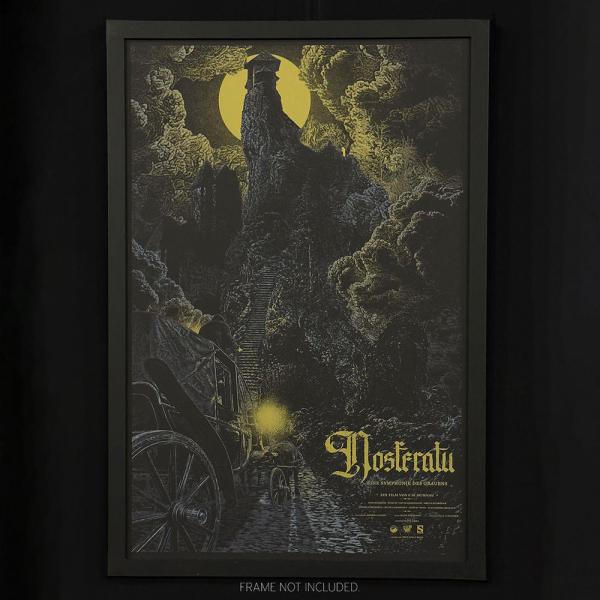
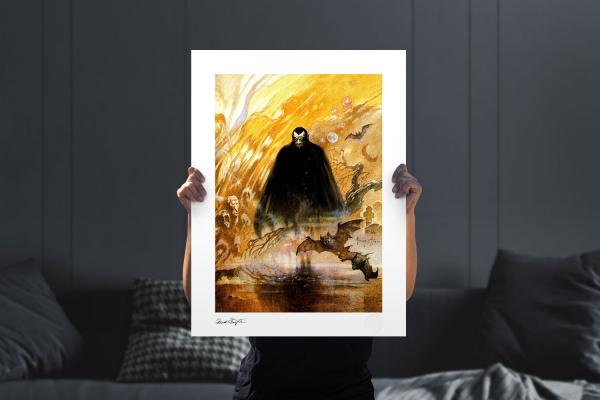
Nosferatu Review: Eggers’ 2024 Update on Classic Horror
A sickening shadow reaches across the Germanic countryside. Everything that falls under its dominion becomes the plaything of Count Orlok, the titular vampire of Robert Eggers’ morbid fairytale Nosferatu.
In this modern retelling, Nosferatu preys on human fears of desire, darkness, and inner evil. It raises unsettling questions and urges its audience to confront the demons they turn away from. The Count may portend something awful for his victims, but for us horror fans, the result is darkly delicious — and a little repulsive. Here’s our review of Nosferatu (2024).
Nosferatu Style & Cinematography

As with any horror film, sound and color palette played integral parts in setting the mood for Nosferatu. And for such an iconic vampire film as F. W. Murnau’s Nosferatu (1922), the pressure to live up to its predecessor was monumental. However, Eggers’ Nosferatu pays clever homage to the original silent film.
In the latest iteration, silence is used just as much as swelling, creeping violins to evoke a sense of dread. This is especially evident in the forest scene when Thomas Hutter (Nicholas Hoult) is traveling to meet Count Orlok (Bill Skarsgård). As the towering trees close in on the traveler, all sound falls away. Hutter finds himself at a deserted crossroads, surrounded only by forest and snowy silence. The lack of sound is almost smothering until Orlok’s phantom-driven carriage finally thunders in from the distance.
Symbolism in Nosferatu
Back in 1922, the original film was in black and white. Eggers’ 2024 reimagining casts the majority of the film in a dismal blue light, especially when Orlok and Ellen Hutter (Lily-Rose Depp) interact. However, this somber cold tone is offset by scenes of intense firelight, especially when we first meet Orlok in his castle. As Thomas enters the Count’s dining chamber, it’s almost as if he’s descending into the pits of Hell itself. The effect really drives home the infernal menace of Count Orlok.
Elsewhere, the film is full of plant-based details. As the Count’s plague creeps across Wisborg, the houseplants inside every home go from full and alive to sickly and wilted. Plus, Ellen and Orlok refer to lilacs multiple times. Traditionally, lilacs represent the first pangs of love, a time when purity and desire mingle with varying results. Lilacs are a gift from Thomas to Ellen in the beginning and they’re present on Ellen’s deathbed. This connection points to the way her innocence was plucked and left to rot, even if Thomas promises to tend to them. No blossom can escape the loss of its petals.
Cast Performances in Nosferatu
section contributed by writer Jasmine Edwards

Naturally, Nosferatu is rounded out by some of the powerhouses of modern acting. Eggers brought Willem Dafoe on after The Lighthouse, another chilling black-and-white feature about madness and isolation. We also have Bill Skarsgård, Lily-Rose Depp, Nicholas Hoult, Emma Corrin, and Aaron Taylor-Johnson dominating the screen. Overall, the cast members bring tense and thrilling emotions to their scenes, but unfortunately, they aren’t entirely complex. Each character remains rooted in their archetype — eccentric scientist, dark villain, hysterical/melancholic woman, pure-hearted hero, and skeptic.
Still, the cast delivered compelling performances within a plot that was pushed more through dialogue than anything else. Depp’s delivery of her monologue, including the line, “I had never been so happy as that moment when I held hands with Death,” is a standout part of the film. For the most part, everyone commits to their character. Their performances help immerse us in the human nature and suffering of Nosferatu’s plague-ridden, rat-infested world.
Themes of Shame in Nosferatu

Nearly every vampire story contends with the troubling nature of desire and Nosferatu is no different. Lily-Rose Depp’s Ellen is the main conduit for Orlok’s terror, though the reasons why are largely left unclear. While there’s something to be said for letting the audience draw its own conclusions, the story itself might have benefitted from diving deeper into Ellen’s connection to the occult and, by extension, Orlock himself.
At one point, Ellen raises a question that’s central to her plight: “Does evil come from within us … or beyond?” It’s fascinating to watch the intimate longing and enflamed repulsion between Ellen and Orlok unfold, but their shared history is all too brief. Through characters like Dafoe’s professor, the audience is led to the idea that darkness dwells within all of us, and it’s our task to face that darkness in order to destroy it. Nosferatu dances around the opposition between science and the occult, even hinting at their dreaded marriage via alchemy. Ultimately, that discussion is overshadowed by a somewhat superficial exploration of Ellen’s shame surrounding her undeniable attraction to the darkness.
Nosferatu Himself

With such a well-known classic horror villain, not to mention Werner Herzog’s Nosferatu the Vampyre (1979), bringing Nosferatu to life once again raises a lot of expectations. Yet Eggers’ interpretation, and Skarsgård’s performance, brings something freshly decrepit to the haunting figure. Even his appearance is unlike previous versions of Orlok.
While the vampyr still has the required ghostly pallor and gnarled, beckoning claws, this Orlok also has a mustache and big fur coat. The result is an ode to Vlad Tepes, the Wallachian overlord whose legendary cruelty adds depth to vampiric lore. From the moment we meet him, Orlok’s rasping breath inspires fear. Every inhale reminds us that he is an ancient entity, a creature that’s “a force more powerful than evil. It is Death itself.” When Orlok’s temper is ignited, the screech of bats echoes in his bellowing fury.
At the same time, Skarsgård infuses the vampyr with his own signature unsettling humor that we previously saw in his turn as Pennywise. After he and Hutter finish signing their estate papers, Orlok mutters, “Now we are neighbors.” Such a simple statement that would otherwise be friendly, yet coming from Orlok it becomes a threat. And despite flashes of humor, the film never strays from reminding the viewer that Orlok is vile to the core. He devours children and inhabits nightmares. “I am an appetite, nothing more.” When evil takes such a nebulous form, it’s all the more difficult to overcome it.
And now the midnight hour has passed. What did you think of Nosferatu (2024)?
Join the conversation with other horror fans over at Sideshow Social Network or in side.show/geekgroup, and don’t forget to Let Your Geek Sideshow!
By Nick Cimarusti

More from Nick
- Spooktacular QUIZ: Which Universal Monster Are You?
- Seasonal Scares: A Horror Movie for Every Season
- Spooktacular Poll: Which Decade Has the Best Horror?
- One of Those Faces: DC’s Clayface Film Review
- The Most Monstrous Villains of Batman’s Rogues Gallery
✍️ Written by Humans, Not AI