She’s Alive! The 90th Anniversary of Bride of Frankenstein
Originally published on July 15, 2025. This article covers the history of the Bride of Frankenstein.
Mary Shelley’s essential novel Frankenstein was first published in 1818, forming the basis of modern science fiction as we know it. Her undead creation has taken on countless new lives since its debut, but what about the monster’s mate?

In 2025, the iconic Universal Monsters film Bride of Frankenstein celebrates its 90th anniversary. Elsa Lanchester’s striking face and beehive hairdo have become synonymous with the Frankenstein story, and rarely now do we see the original Frankenstein’s monster separated from his hissing honey.
But that story was entirely an invention of the films. Shelley originally had a very different message in mind for the female of the species. Now that Maggie Gyllenhaal’s The Bride! has been released into theaters, let’s peel back those bandages even further. It’s time to examine the fascinating history and future of the Bride of Frankenstein.
The Bride in the Original Novel
Many might be surprised to learn that the Bride of Frankenstein character doesn’t really exist in the original text. At least, not in the way the films suggest.
-

- © 2024 Bernie Wrightson

In Shelley’s seminal work of fiction, Victor Frankenstein does in fact undertake the task of trying to create a mate for his monster after the creation demands, “You must create a female for me with whom I can live in the interchange of those sympathies necessary for my being. This you alone can do, and I demand it of you as a right which you must not refuse to concede.” On the page, the monster is a much more tragic and articulate being, envious of his master’s betrothal to Elizabeth Lavenza and his own general lack of companionship.
While the doctor initially refuses, he and his creation argue back and forth, the monster promising to disappear into South America with his mate. He promises never to torture Victor again. Fearing for his family’s safety, Frankenstein eventually relents and sets to creating a second reanimated being — but he never finishes her.
In fact, he destroys her after spiraling into anxiety over her ability to potentially produce monstrous offspring. Frankenstein also notes that she might very well hate his creation, which would make the creature miserable all over again. So he destroys her while she is half-finished, in full view of his creation. In retaliation, the monster then kills Frankenstein’s new wife Elizabeth.
Master of the Monsters
Victor Frankenstein’s ultimate reasoning for destroying the female boils down to fearing a loss of control. The idea that the female monster would be able to bear children worries him that their offspring might overtake the earth. He knows he cannot force her to love his original creation just as he cannot force that original creation to listen to him.
The female monster (never referred to as a “bride”) does not speak and is generally not given a physical description in the text, raising fascinating questions and reflections on the power dynamics within the story and her objectification. She is seen as something that would “humanize” the monster and give him purpose. Frankenstein had no moral qualms about creating a singular male monster, but in the context of him “playing God” and creating his “Adam,” then the woman’s role in the story would eventually be to tempt and lead the creation astray.
While not an afterthought by any means, the female monster’s place in the text is just one small facet of the larger conflict between Frankenstein and his creation. So how did she get to be so well-known in modern media?
Bride of Frankenstein by Universal Pictures

In 1935, director James Whale helmed a daring sequel to 1931’s Frankenstein film from Universal Pictures. Titled Bride of Frankenstein, this film expanded on the subplot from the original novel involving the monster’s female mate, with some notable original additions. Actor Boris Karloff returned as Frankenstein’s monster while actress Elsa Lanchester received acclaim for her dual role as Mary Shelley and the Bride.
The film is framed by the story of Mary Shelley, Percy Shelley, and Lord Byron on holiday at Lake Geneva. This is based on the real world origin of the original Frankenstein novel, where Shelley, Byron, and John Polidori challenged one another to write the best horror story. In the film, the author says there is more to her tale, continuing where the 1931 film ended.
The Face of the Silver Scream
Once again, despite how prevalent an image her face has become in pop culture, the Bride only has about five minutes of screentime during the film’s 75-minute duration. Dr. Henry Frankenstein (as he’s known in the Universal Pictures films) is goaded by Dr. Pretorius, a new invention of the movie, to once again create life in the form of a mate for his monster. The monster, meanwhile, is shown to be learning language and concepts like “friend” and “good” before being introduced to his bride.
Despite succeeding in reanimating the female flesh, the Bride rejects her monster mate, hissing and screaming at him. The monster is devastated, and then destroys the laboratory while Henry and Elizabeth flee, trapping himself, Dr. Pretorius, and the Bride inside.

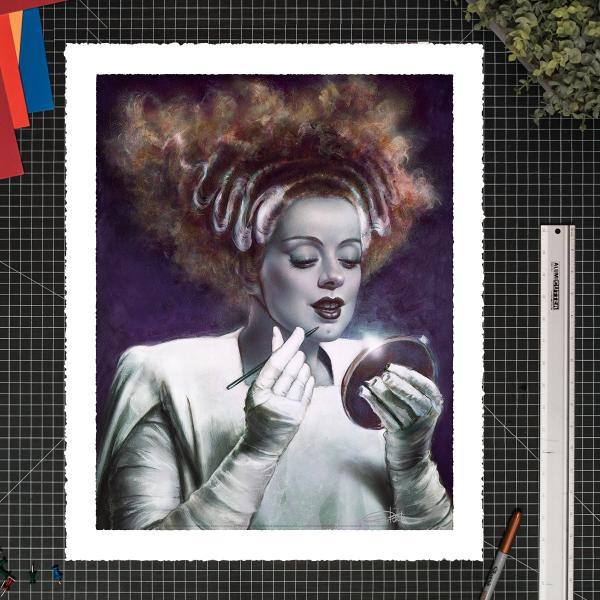
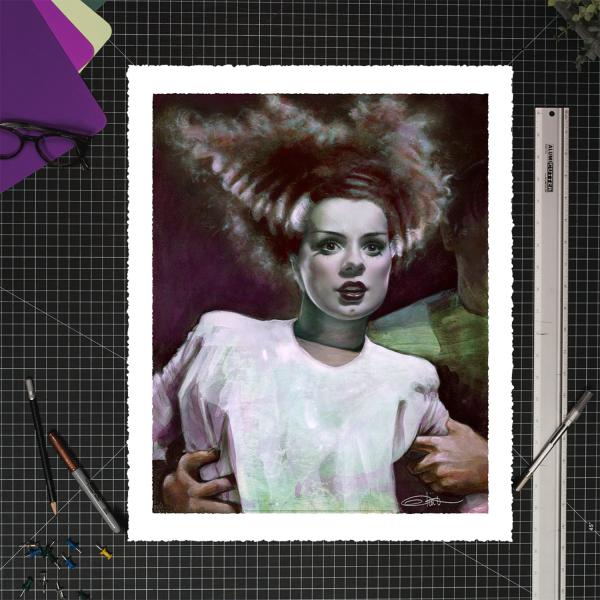
Elsa Lanchester’s performance as the Bride is ultimately what makes her so compelling and iconic. The tall hair emblazoned with white stripes, her bandage gown, and her pale features create a stunningly delicate contrast to the large, blocky design of Karloff’s monster (even more striking when the characters made the leap into color).
Even if the fated monsters believe, “We belong dead,” they continue to live on as beloved icons in horror media, goth romance, and pop culture in general.
Universal Studios’ Epic Universe

One of the many ways that the Bride lives on, even within the world of Universal Studios, is through the new Epic Universe theme park that opened earlier this year. Here, she lives within the world of Darkmoor, a village where Dr. Victoria Frankenstein (descendant of Universal’s Henry Frankenstein) seeks to bring monsters under her control and restore honor to her family name.
In the park, the Bride is a face character with a meet and greet. Interestingly, she is the “same” Bride as in the 1935 film, while the traditional Frankenstein’s Monster character is a “new” creation by Victoria. The Bride, however, remembers her old companion, and will talk about him when asked.
In other Universal Studios attractions, such as during Halloween Horror Nights, the Bride has taken on the role of a mad doctor and even a monster hunter. In 2024, she was featured in the Eternal Bloodlines haunted house, teamed with Saskia Van Helsing to defeat Dracula’s daughter.
The Future of the Bride of Frankenstein
The Bride! directed by Maggie Gyllenhaal
It’s clear there’s plenty of spark left in the Frankenstein story, so fans don’t need to worry. As for where we’ll next see the Bride, actress and filmmaker Maggie Gyllenhaal has written, directed, and produced The Bride!, a monster film set to release in 2026. It draws inspiration from the Universal Pictures film as well as the original aspects of the female monster from Mary Shelley’s 1818 novel.
The film’s premise has been shared as the following:
In 1930s Chicago, Frankenstein’s monster asks Dr. Euphronius to create a companion for him. They give life to a murdered woman as “the Bride,” sparking romance, police interest and radical social change.
Actress Jessie Buckley plays the titular Bride opposite Christian Bale as Frankenstein’s monster. While not a true Universal Monsters picture, as the film is being released by Warner Bros., it honors the character’s literary and filmic roots for a new and unique take on the tale. Its theatrical debut is March 6, 2026.
The Bride in the DCU
The Bride is also the leader of Task Force M in the animated Creature Commandos series created by James Gunn. This show serves as the first entry in the revised DC Universe under Gunn’s direction, for the chapter Gods and Monsters. Actress Indira Varma (Allura Vysoren in Critical Role: The Legend of Vox Machina) lends her voice to this version of the character, who is considered a homunculus and was created as a companion for Eric Frankenstein.

The character’s origins, while similar to the original novel, vary in the comic book context of the series — notably, Victor was her lover, though he was murdered by Eric (the name of Frankenstein’s original monster). Eric then stalks the Bride through the centuries, until they encounter Amanda Waller and her new initiative to create a team of monsters to execute missions.
Creature Commandos has already been renewed for a second season, and while there are no definite plans revealed for a live-action version, Gunn has cited the potential for these characters to appear in future projects across the DCU.
You have to admit, she looks great for 90 years old! Our collective fascination with the Bride of Frankenstein clearly shows no signs of decay after all these years, and there’s clearly still a wealth of ways to explore her story in movies, television, comics, and more.
Make sure you RSVP for the latest news on Sideshow’s upcoming Universal Monsters collectibles.
Then, tell us your favorite depiction of the Bride of Frankenstein! Share your thoughts with other Universal Monsters fans at side.show/geekgroup or in the Sideshow Social Network. And don’t forget to Let Your Geek Sideshow!
By Amy Chase

Connect with Amy
More from Amy
- Ready Player BOO! The Best Horror Video Game Jumpscares
- How Terminator 2 Achieved Iconic Special Effects
- Psychic Type Pokémon Weaknesses and Strengths Explained
- How Was Mewtwo Created in the Pokémon Series?
- Hot Final Girl Summer: Your Summerween Movie Guide!
✍️ Written by Humans, Not AI
Related Products
The Bride of Frankenstein