Art Explained: What Is a Giclée Print?
When it comes to fine art prints, there are many options. As a collector, it may be overwhelming to choose exactly what fits your style, aesthetic, and home decor. After all, most of us want a cohesive collection that blends seamlessly with our everyday, geeky lives. Movie posters, fandom prints, and more all display our tastes in sometimes subtle, but always high-end, ways. But when presented with your choices, how do you know what’s right?
Lots of it comes down to understanding the correct terminology. After all, what is a giclée print? What’s a lithograph, a screenprint, or a metal print? And finally, how do these classifications change what the print looks and feels like in your personal gallery? Learn more about these terms and types below to see which artwork best suits your walls.
Giclée is a high quality printing method

Pictured: Darth Vader™: Dark Lord’s Fury Fine Art Print by artist Vincenzo Ricccardi
Ultimately, giclée, lithograph, and screenprint are simply different names for different printing methods. Each method creates distinguishable characteristics that help collectors tell which is which. And if you can’t tell yet, that’s okay! You can train your eye using your own art collection. Most commonly, of course, Sideshow utilizes giclée printing. You’ll see the word on almost all of our art print product pages. And you can go look at your own prints now to see if you can tell what we’re talking about.
Take the Star Wars™ art above, for example. With such a bold piece, we opt for the most sophisticated and highest quality printing method available on the market for fine art reproduction. We can use giclée printing for both high-end heavyweight paper and cotton canvas. Derived from a French verb that translates as “to spray,” the term giclée refers to the use of state-of-the-art, large format ink-jet printers. These printers spray microscopic jets of ink directly onto the paper or canvas, a slow and deliberate process which provides superior color accuracy, contrast, and depth.
How is Giclée different from Lithographs or Screenprints?

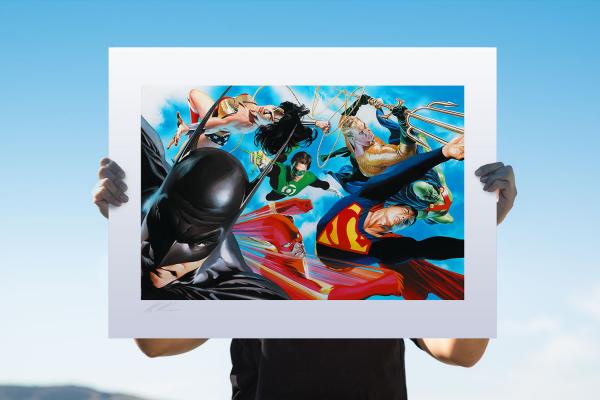
Pictured: Last Son of Krypton Fine Art Lithograph by artist Alex Ross
Lithograph
Look, up in the sky! It’s a bird, it’s a plane, it’s a lithograph! The traditional method of lithograph printing, known as “stone lithography,” originated over 200 years ago. Now, we utilize modern technology to replicate traditional techniques. Offset lithography applies one of four colors (cyan, magenta, yellow, and black) at a time onto a plate. Then, the inked area is transferred to a large rubber cylinder. Finally, the image is essentially stamped onto the print paper. In general, Sideshow’s lithographs are produced on bright white archival economy papers, with a smooth-to-the-touch finish.
Screenprint
Meanwhile, screen printing is a complex and extremely labor intensive stencil-based printing method. It requires an expert level of craftsmanship in order to individually and manually separate color layers from the original image. After, the color layers are applied one by one in order to eventually build the final image. Thus, screen printing produces vibrant colors that are hard to replicate by other printing techniques. It also allows us to apply special effects such as metallics or glow-in-the-dark inks. Sideshow’s screenprints are typically printed on 100# French papers.
There are also HD Aluminum Metal Prints!

Pictured: Asajj Ventress™: Ascension HD Aluminum Metal Art Print by artist Darren Tan
Dude, that’s metal!! No, really. A high definition (HD) aluminum print features a brilliant, durable surface and unsurpassed color vibrancy — especially when it comes to reds. Sideshow’s aluminum prints are printed on ChromaLuxe metal panels using a process known as dye-sublimation. Dye-sublimation is just a fancy phrase for infusing and transferring dyes directly onto metal via extreme heat and pressure. The final product is scratch, fade, fire, and water-resistant. These can be cleaned with all-purpose household cleaners and microfiber cloth, allowing your museum-quality print to retain its shine with minimum effort.
Differentiating Giclée, Lithograph, Screenprint, and HD Aluminum

Pictured: Spider-Man No More (Black Foil) Screenprint by artist John Romita Sr.
Basically, you can differentiate between these four printing methods by remembering what it takes to produce the final image. Giclée prints are sprayed on. Lithographs are stamped on. Screenprints are stenciled. Finally, HD aluminum prints are dyed. Knowing just how much work goes into producing your artwork also helps you appreciate it even more. From the character represented on the print and what it means to you to how much effort went into bringing that print to your hands, know that every step of the process is about care, precision, and the best in all things fine and geeky.
Additional Specialty Printing Methods
Sideshow also offers gallery wrapped canvas prints, wood blocks, and has even produced skateboard decks! Whenever we’re presented with the opportunity to carry or produce a new print, we take great care in deciding which format best suits each incredible image. It’s integral to our process that we always consider the best methods of presentation for these unique and collectible images. As passionate fans ourselves, we always keep collectors’ best interests and desires in mind.
Do you have more questions about art terminology? Are you fascinated by the concept of hand-deckled edges, printer’s proofs, and how we achieve an authorized, automated artist signature? Learn all of this and more on our Art Prints FAQ webpage. We’ll even explain exactly how we ship your prints and how you can care for them once they’re in your home.
We hope reading about the types of printing used in our studio help you make the most informed decision about your artwork. Once you’ve selected your favorite format, share your home gallery photos at side.show/geekgroup or in the Sideshow Social Network. And, as always, don’t forget to Let Your Geek Sideshow!
By Sideshow

Connect with Sideshow
More from Sideshow
- Spooktacular 2026 Event Overview and Schedule
- First Look: Sergeant Hound Sixth Scale Figure by Hot Toys
- First Look: Threezero David Martinez Edgerunners 1:6 Figure
- First Look: Hot Toys Victor von Doom Sixth Scale Figure
- First Look: Hot Toys Palpatine (Darth Sidious) 1:6 Figure
✍️ Written by Humans, Not AI